
From X-ray source to production-ready battery inspection
How Excillum supports VCbattery in transforming high-performance CT into industry-ready inspection
Interviewee
Bernhard Mürkens, Head of VCbattery at VisiConsult
Application
High-throughput CT for industrial quality control
X-ray sources
MetalJet E1+
MetalJet F
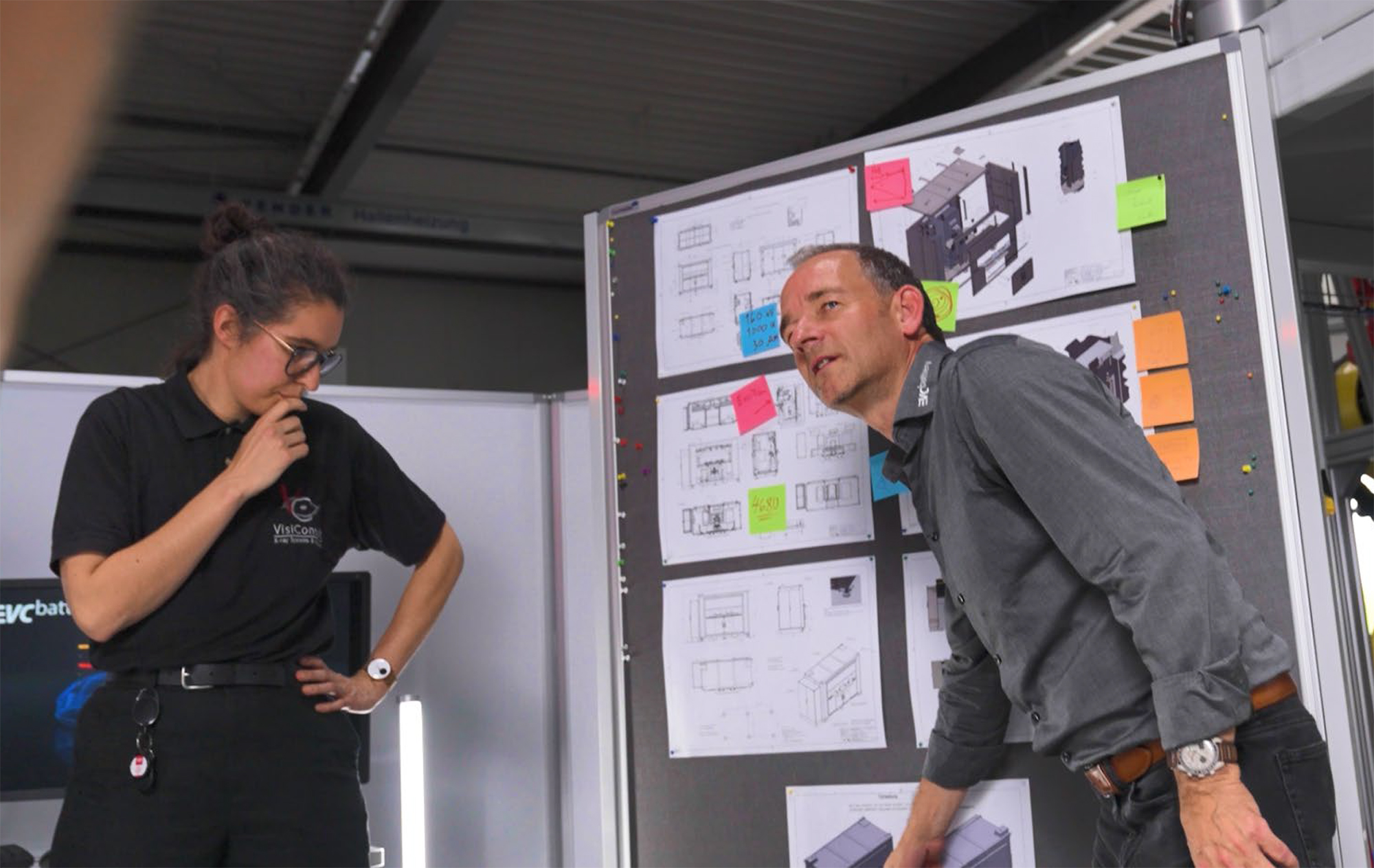
Bernhard Mürkens, Head of VCbattery
When VCbattery set out to build a high-speed CT platform for inline inspection of EV battery cells, the challenge was never just about brightness or resolution on a spec sheet. It was about finding a source partner willing to engage deeply with the system-level details that determine whether an advanced quality control system will run around the clock on a factory floor.
“Excillum brings deep expertise in X-ray physics and source technology, combined with a very collaborative engineering mindset,” says Bernhard Mürkens, Head of VCbattery at VisiConsult. “The close technical exchange between our teams has been crucial in optimizing system performance, and their support in integration and training has been highly valuable.”
Towards a new era in quality control
Many battery manufacturers now recognize that high-throughput CT is on a path to becoming part of mainstream quality control. The question is how to build the integrated technologies, data handling and process controls to make it perform in the extremely demanding production conditions of a modern gigafactory. A key part of this challenge is where Excillum and VCbattery come together: pairing Excillum’s X-ray source expertise and collaborative engineering approach with VCbattery’s application expertise to turn inline CT from a promising technology into an industrial production system.
“A core challenge today is combining speed with sufficient resolution to detect critical defects – which is exactly where advanced CT solutions come into play,” explains Bernhard Mürkens. “Battery quality control is still in a transition phase – from sampling-based inspection to high-rate and ultimately 100% inline inspection.”
Excillum brings deep expertise in X-ray physics and source technology, combined with a very collaborative engineering mindset.
The close technical exchange between our teams has been crucial in optimizing system performance, and their support in integration and training has been highly valuable.
Bernhard Mürkens,
Head of VCbattery
What VCbattery needed from a source partner
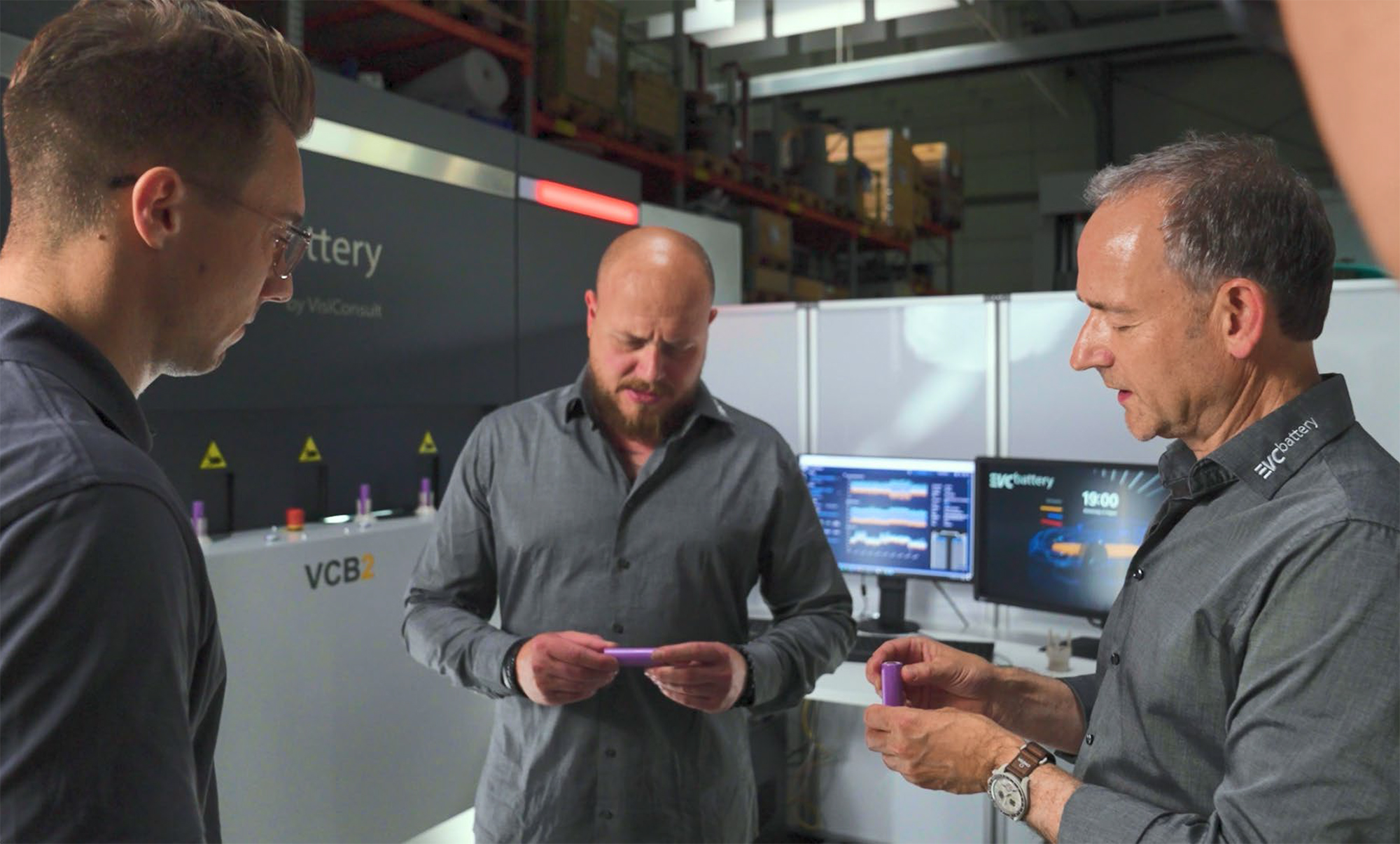
Christian Gück, Head of Sales at VCbattery (middle), and Bernhard Mürkens, Head of VCbattery (right).
VCbattery’s customers — Tier 1 cell manufacturers, OEMs and key EV suppliers — are already moving toward inline inspection, but they expect CT systems that reliably perform in complex, integrated and highly automated manufacturing environments. That means predictable cycle times, stable image quality, and high uptime, rather than peak performance in ideal conditions.
For Bernhard Mürkens and his team, traditional sources had become a limiting factor. “Traditional source technologies limited achievable throughput in terms of flux and long-term stability,” he recalls. To make inline CT viable, they needed more than next-generation system technologies.
The brief was clear:
- Deliver significantly higher photon flux while maintaining a small and stable focal spot to support full-cell CT scans in seconds.
- Support integration into a 24/7 industrial system, including mechanics, cooling, shielding, interlocks and service access.
- Work collaboratively on the engineering and physics constraints in the interface between source performance and system performance.
Optimizing the VCB2 platform with MetalJet technology
In the current VCB2 configuration, VCbattery integrates the Excillum MetalJet E1+ as the X-ray source. It delivers significantly higher photon flux while maintaining a small and stable focal spot than conventional microfocus tubes. This brightness makes it possible to perform full-cell CT scans of cylindrical EV cells within cycle times suitable for high-throughput industrial inspection down to a view seconds while maintaining micrometer-level spatial resolution, depending on the application and inspection requirements. In addition, the MetalJet is a mature source platform with the reliability and lifetime required for 24/7 industrial operation.
The overall inspection performance results from the interaction of X-ray source, detector technology, motion system, image acquisition strategy, automation, shielding, software integration, and application-specific defect detection.
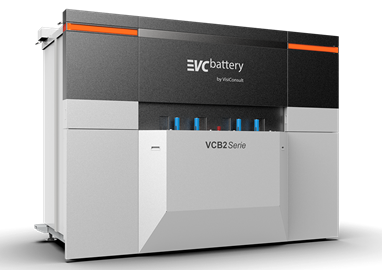
The VCB2 Superscanner
For battery manufacturers, the resulting VCB2 performance represents a significant advance in how CT can be used.
“The VCB2 Superscanner represents an important step toward industrial inline CT inspection beyond offline or sampling-based approaches,” Mürkens notes. “Customers benefit from significantly higher defect detection rates, reduced scrap, and improved process transparency.”
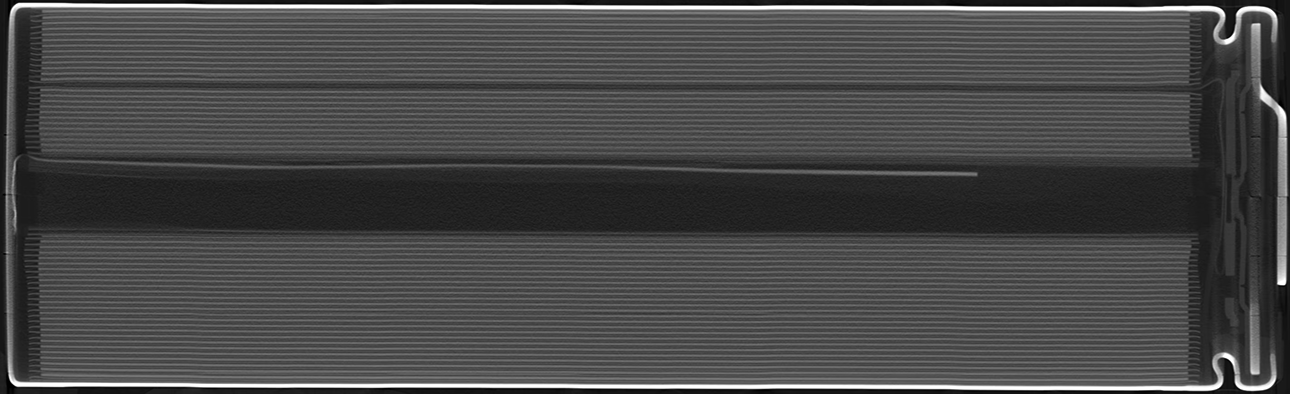
A 10 second full CT scan of a 2170 cylindrical cell, captured by the VCB2 Superscanner.
Improving system performance together

Emil Espes, Head of Battery Segment at Excillum, and Bernhard Mürkens, Head of VCbattery.
What made this possible, from VCbattery’s perspective, was not only MetalJet’s performance, but Excillum’s extensive technical support during integration and industrialization. Teams from both companies defined shared performance targets around cycle time, resolution and uptime, then iterated together on scan trajectories, source settings, detector choices and imaging chain optimization to meet those targets under real-world constraints.
That support is now extending into next-generation platforms, as VCbattery is currently integrating the Excillum MetalJet F-series. “The F-series platform is currently being evaluated and is expected to provide additional opportunities in stability, power and integration capabilities,” Bernhard Mürkens notes.
“This opens up opportunities to further increase throughput while maintaining or even improving defect detectability. It also enables more robust operation in demanding production environments.”
From VCbattery’s perspective, this is what distinguishes Excillum as a partner. “Excillum is not just delivering a technology. They are actively contributing to system performance and innovation,” Mürkens emphasizes. “Their openness, technical depth, and commitment to joint problem-solving make them a true partner in pushing the boundaries of what is possible in industrial X-ray inspection.”
Excillum’s openness, technical depth, and commitment to joint problem-solving make them a true partner in pushing the boundaries of what is possible in industrial X-ray inspection.
Bernhard Mürkens,
Head of VCbattery
A model for other OEMs
Although the VCB2 is built for cylindrical EV cells, VCbattery’s collaboration with Excillum points to a broader pattern in industrial X-ray systems. The critical work lies in turning source characteristics into predictable system behavior: cycle times that hold despite process variations, image quality that does not drift, and uptime that survives real inline production demands.
VCbattery’s experience shows how OEMs can apply Excillum’s source platforms within their own systems, supported by application engineering and source expertise throughout the integration and industrialization process. For VCbattery, this includes complete industrial solutions covering everything from automation and handling to data management and MES connectivity*. The same hands-on problem-solving is now shaping projects in semiconductor and electronics inspection, advanced materials and other industrial applications.
For these innovators, the question is not only what an X-ray source can do in isolation, but what it takes to transform these capabilities into reliable tools for cutting-edge imaging, inspection, and analysis. For VCbattery, this means continuing to work closely with Excillum to turn demanding specifications into systems that run reliably in production.
* MES (Manufacturing Execution System) connectivity allows the inspection system to exchange production and quality data with the factory’s manufacturing software, helping each battery cell and its inspection result to be tracked through production.