Battery research
Inline X-ray computed tomography (CT) is a powerful inspection technique that can further reduce the risk of defects and recalls, compared with today’s 2D X-ray inspection techniques. However, to achieve the levels of inspection coverage, throughput and resolution necessary for high-volume battery production, a high-power X-ray source with a micrometer-sized X-ray spot is necessary. The Excillum MetalJet E1+ source makes this possible, achieving a full scan with micrometer resolution in just one second, or less.

Application examples
Battery research
The video below shows a NanoCT of a lithium ion battery cathode material, where the microsctructure of the material can be clearly resolved. Both the aluminum cathode collector and the active LiCoO2 layer are visualized and can be analyzed further thanks to the high resolution enabled by the small X-ray spot of the Excillum NanoTube N3.
These results were generated at the applications lab at Excillum in Sweden, using our NanoTube N3 and a detector from Dectris. Visualization and analysis was made using ORS Dragonfly.
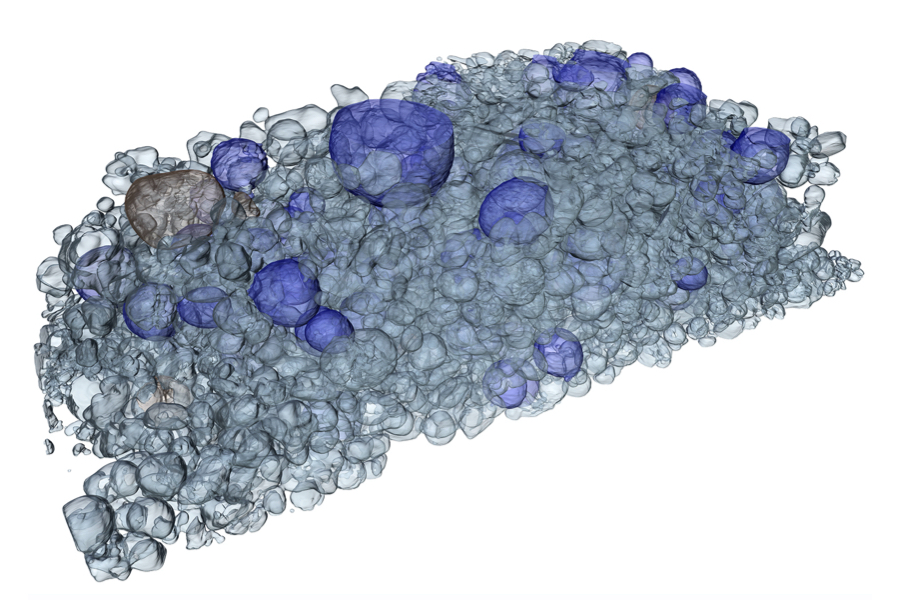
In the image below, a 3D rendering of the NanoCT of a lithium ion battery cathode (NCA/LCO-E) shows particles of different sizes. Voxel sampling 140 nm.
This NanoCT system with the Excillum NanoTube has been designed, developed and commissioned at Fraunhofer IIS, Würzburg, Germany. Together with an EIGER2 CdTe detector, the system has been optimized for materials characterization and NDT applications.
Challenging high entropy oxide samples
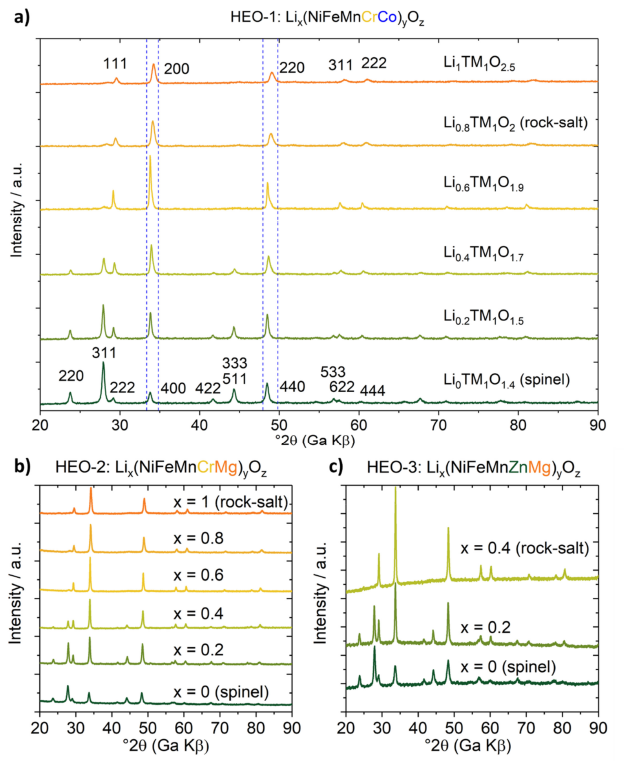
Researcher at Karlsruhe Institute of Technology utilized a STOE Stadi MP goniometer powered by a MetalJet D2+ to investigate challenging high entropy oxide (HEO) samples. The challenge was to measure a large number of samples and that for every type of sample only a small amount was available. By illuminating the powder samples with a focused bright and small beam of quasi monochromatic Gallium K β radiation, a good signal to noise ratio was obtained with an acceptable measurement time. Powder XRD data sets of a HEOs with varying composition are illustrated here.
For more details, please see the references:
Wang et.al.: Spinel to Rock-Salt Transformation in High Entropy oxides with Li Incorporation. Electrochem 2020, 1, 60–74;doi:10.3390/electrochem1010007
Wang et.al.: Multi-anionic and –cationic compounds: new high entropy materials for advanced Li-ion batteries. Energy Environ. Sci. 2019; doi: 10.1039/c9ee00368a